
I’ve lived in California for most of my life. And as a baby liturgist, I always knew that one day I’d study at Saint John’s University in Collegeville, Minnesota, because from what everyone told me, that was the birthplace of the liturgical movement in the United States. So in the summer of 2001, I flew from LAX to MSP, rented a car, turned left, and went about 90 miles to where there were only cows, pine trees, mosquitoes, and monks.
Now I had been raised on a steady diet of OCP and GIA, a lot of badly played organ, and a good portion of decent “folk” ensembles. I had little exposure to hymnody, chant, and the organ as the primary instrument next to the voice, much less the daily practice of the hours. So aside from finding out that “pop” meant soda, discovering the wonder of brats and kraut, experiencing the beauty of lightning, and learning never to take a path to the lake through the woods without wearing a thick layer of Deet or a bio-hazard full-body suit, Saint John’s opened up for me an entirely new window into our liturgical tradition, and I am most grateful for everything that place taught me.
There, I learned about the liturgy—how it works and how it doesn’t, why, and why we all need to be so attentive to it—as much from praying it daily with the monks as I did from studying it in the classroom. Each fed and flowed from the other. That rhythm of daily prayer and study became for me my own ora et labora.
On the first day of my first six-week summer there (just before that fateful detour into the woods), I visited the grave of Virgil Michel, OSB, and asked him to help me. In honesty, after about two weeks, I thought I had made a mistake in coming there. Central Minnesota is worlds apart from Southern California in so many ways. But somehow Virgil and all the monks there got me through. And through it all, I fell even more deeply in love with the liturgy and with Saint John’s.
Today is the Benedictine community’s feast day, always a grand event at the Abbey. My most favorite memories of this day are the banner bells calling us to pray (and rung again as we sang the Gospel Canticle at the office) and this passage proclaimed every year from Sirach:
Frequent the company of the elders; whoever is wise, stay close to him.
Be eager to hear every godly discourse; let no wise saying escape you.
If you see a person of prudence, seek that person out;
let your feet wear away the path to his doorstep! (6:34-36)
Good advice for us all.
At the graduation banquet for the School of Theology·Seminary, each graduate gets to say a few words before his or her fellow classmates and professors. I want to share with you what I said at my graduation because I think it conveys the beauty I saw at Saint John’s and my deep gratitude for how that community has shaped me in this work of the liturgy we share. On this feast day, I remember them and pray for their continued blessing.
Saint John’s University
School of Theology·Seminary Summer Graduation Banquet
July 22, 2005
Years ago, as I was preparing to begin my first real full-time liturgy job, I did a very Californian, Gen X thing and got a tattoo to mark the transition. And two weeks before I left for Saint John’s for this last summer of study, I did another very trendy thing and got my navel pierced. I figured if I could survive poking a hole in my belly-button, I could handle comps. These may sound like strange ways to mark these significant events, but someone told me that my last name, “Macalintal,” means “marked.” So marked I would be.
I wouldn’t have believed it back then when I started five years ago, but I believe it now. I believe we have all been marked by this place called Saint John’s, marked by something deeper than superficial tattoos and piercings.
We have been marked by feast and vigil, stone and colored glass, piercing bell and penetrating silence, wooden jubilee canes and simple pine coffins. We have been marked by the rhythm of morning and noontime, evening and night, hot sticky days of summertime heat and welcomed breezes on lazy afternoons. Mosquito and deerfly have left their marks on us, calligraphied rainbows of God’s Word have illumined us, potters hands have shaped us, music has infiltrated us, and teachers have breathed Spirit back into us.
In this place, we have been measured by the rule of Benedict, scrutinized by the alien figure of John the Baptist, and pondered over by the gaze of Mary, the bearer of Wisdom. Here we have breathed the same Spirit-filled air as those named Virgil, Aelred, and Godfrey, and we have been revivified by the loving spirit of those such as Patty, Bill, and Abbot John.
I will forever be marked by the memory of professors named Anthony, Dominic, and Theresa, Max, Christian, and Jim, Thomas, Martin, Kevin, and Charles, and by the stories of so many who have come through the summer doors of the School of Theology.
But most of all, I will be marked by the profound beauty that I have witnessed here during my five summers—that deepest beauty of creation and humanity, time and space struggling to live together in harmony; the beauty found in the cultivation of flower and harvest, in the discipline of musicians and the expectant hope of the potter and kiln, in the lectures that become poetry and you just have to put down your pen and listen. It is the beauty of student and teacher striving for truth and clarity and in the end realizing that it is all tremendous mystery. It is the beauty of a community of faith, living daily in work and prayer, struggling to be faithful through abuse and accusation, apathy and agedness. It is people of faith, working in parishes and schools, beaten down by despair and disappointment, disrespect and division, living through divorce, debt, and doubt, yet still loving this sinful and holy Church of ours, and giving all they have to see it breathe life again into our weary world.
It is this beauty that I will live for and work for and strive for, Sunday after Sunday, through word, music, movement, and environment, through action and stillness, time and timelessness—the beauty of tired hands presenting broken gifts and broken lives and knowing that they are the best we can offer before the aching beauty of the cross.
I give thanks for all of you, especially for my conspirator, Nick, the one who breathes with me. I will miss this place and all of you connected with it, but I will take with me the mark of beauty that you have impressed upon me. I believe we have come from Beauty, and I believe we will gather once again in Beauty.
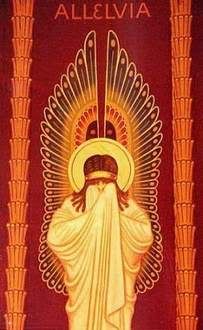
My first day here, I came to this Great Hall and fell in love with these angels—not your Hallmark card angels, but angels you don’t want to mess with. Now the circle has closed and I return here again to this Great Hall and offer to you these words of love by Annie Dillard.
Angels, I read, belong to nine different orders. Seraphs are the highest; they are aflame with love for God, and stand closer to him than the others. Seraphs love God…. The seraphs are born of a stream of fire issuing from under God’s throne. They are, according to Dionysius the Areopagite, “all wings,” having, as Isaiah notes, six wings apiece, two of which they fold over their eyes. Moving perpetually toward God they perpetually praise him, crying “Holy, Holy, Holy…. But according to some rabbinic writings, they can sing only the first “Holy” before the intensity of their love ignites them and dissolves them again, perpetually, into flames. (Holy the Firm)
May we all be marked by beauty, ignited by faith, and dissolved by love for all those whom our God loves.
Please leave a reply.