
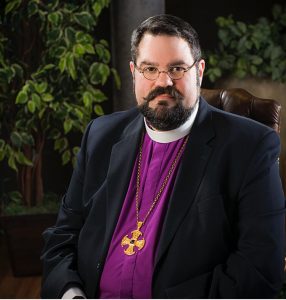
by The Rt. Revd William G. Cliff, Bishop of Brandon
There are moments when I feel a tremendous affinity for the early church gathering together as the people who have heard the transforming word of Jesus. In dealing with the institutional and systemic racism which is so much the subject of our discourse these days, I am reminded of the groups whom the earliest apostles gathered together: slaves, tax-collectors, the rich, the poor, working folk, labourers as well as the educated. These are people the empire would usually ignore and discard as well as people who would put their position in society at risk were it known that they had come to believe in the man from Nazareth.
I spend a great deal of time in very small and quite isolated parishes when I am doing my visits around the Diocese. As bishop, I work with parishes situated very far geographically from the nearest major city. In these small churches, sometimes in a forest, sometimes on First Nation’s reserve, sometimes in a small town we gather together. We sing and pray, I preach and then we go to the altar as we celebrate together the mysteries of Christ’s body and blood. I am very conscious of the faith of the people of my diocese and their situations geographically, politically and economically.
As a bishop serving the communities I have described above, it has become more and more clear to me that in the liturgy of the church, we are proclaiming a kingdom that desperately desires to be revealed. The liturgy, as I experience it, is the ritual proclamation of a new humanity, a new heaven and a new earth. We are gathering as a people who have been set free and we thank the God who has made the self-emptying choice to make our freedom real and available in Jesus Christ. In the fevered pitch of our current discourses on freedom, I beg you to understand I am not thinking primarily of political or economic freedom, though there are those implications to God’s action.
Being set free from fear, sin and death is the inheritance of the children of God. What follows is the story of how an ordinary liturgy in a far-flung parish with a congregation of people who live on the margins of economic or political power, modernity witnessed the Kingdom-that-desires-to-be- revealed breaking through.
It is a hot afternoon midweek in late June. The service is Confirmation and First Holy Communion in a traditional Indigenous community. The parish gathers in an old construction trailer that has been retrofitted for the purpose because the church was burned 30 years ago. There is one small stained glass window over the altar and nothing of the furniture matches. The families that have gathered are warm and kind and the Rector is nervous but happy that Confirmation is being celebrated. The little room to the side of the church which serves as combination Sunday school room, sacristy, meeting room and pot-luck staging area is pumping out the smell of bannock and beef roast.
The hymns are in both Cree and in English so everyone can sing something they know. The older generation speak Cree and the younger speak English – an echo of the damage done by residential schools. The ceiling is so low that wearing a miter is an acrobatic act. The bishop’s chair in the sanctuary is the best chair of all the seating – it is re-purposed as well, from a high backed hospital visitation chair. In that small ATCO trailer, with florescent lights buzzing, a small community six hours from a major city gathers and testifies to the glory of God and their freedom in the gospel.
When it is time to lay hands on the candidates, they line up and make their promises, flanked by their sponsors (grandmother and aunties). As we go down the line, there is fear in one young man’s eyes. He has been catechised by his mother and grandmother. They have been solemn about the promises to be made and the responsibilities that follow. I am a large man, and when wearing all the rig that goes with being a bishop, I know some might be intimidated. I smile at him and try to be as reassuring as I can be. I lay hands and pray – and the young man is confirmed, surrounded by his family and the liturgy continues.
There is a genuine holy sense about this gathering. We proceed to the Eucharist and when it is time to receive communion, one by one each of the confirmation candidates comes to the rail, kneels and is surrounded by mother, father, grandparents, aunties and uncles who have followed them to the rail – a living cloud of witnesses. The young man is still nervous and when I approach with the host he looks fearfully at his parents and then at me – nervous and unsure of what he is supposed to do. Just then his grandmother placed her hands on his shoulders and smiles at him. I offer him the body of Christ and he receives it – and his tears began to flow and his face was lit up with joy, as were the faces of the whole of his family, who I communed as they stood around their child. He had been set free from his fear.
This varied community, all sorts and conditions of mortals who have come together to attest to the action of God in making them free from fear, sin and death, marked me. The dignity and wisdom of the mothers and grandmothers who taught the faith to the next generation in their own language has moved me deeply. This community is more like the early church than I had considered. They were not weighed down by the modern day assumptions about church. The fact that this church sits on their land, beside their river and surrounded by generations of the dead who have been laid to rest in faith, means more than stained glass or matching furniture. These women have a deep commitment to the freedom that the kingdom of God meant for them in that place. That freedom and dignity gives strength; strength as they contend with forces no less dangerous than those faced by the early church, made worse by their situation far from the centers of power.
Through their teaching, singing, patience and wisdom I learned about the Kingdom-that- desires-to-be-revealed alongside their boy. That day heaven broke into an ATCO construction trailer that was sheltering a church, and the children of that Easter covenant were transformed. I learned a little bit more about what the new humanity, new heaven and new earth looked like. I also observed the power of the liturgy to connect and transcend the things around us and truly to unite us in Christ.
* * *
The Rt. Reverend William G. Cliff has served as the Bishop of the Diocese of Brandon in the Anglican Church of Canada since 2016. Trained as a singer and musician, Bishop Cliff has used music through the whole of his ministry – serving as a Canon Precentor, concert singer, college chaplain and parish priest since his ordination in 1992. Dedicated to the ecumenical vision of the church, Bishop Cliff team taught a course in ecumenism in the at the local Roman Catholic seminary while he served as chaplain the nearby Anglican college. Immediately before election to the episcopate, Bishop Cliff served for 13 years as the Chaplain to the community of Huron University College at Western University in London, Ontario. He now rejoices and give thanks for the people of the Diocese of Brandon who are as diverse a population as you can find on the Canadian Prairie.

Please leave a reply.