
More than a year ago I wrote about my “Liturgical Crash Course” which I have taught every year since 2006. After I had published that course I got the opportunity to follow up with another introductory book, namely on the Liturgy of the Hours (in the broader sense of Divine Office as well as the Roman Catholic LoTH after the Second Vatican Council). I do not teach this on a regular basis, but over the years courses on the LoTH were assigned to me at different schools of Catholic Theology in Austria and Germany.
I can hardly imagine a field where the students’ previous knowledge differs as much as here: While religious people and seminarians deal with the Office every day, most lay students have no experience whatsoever with that sort of liturgy since it is almost completely ignored in Catholic parishes. But even those who know the Office from their own experience are mostly unfamiliar with the history and the academic terminology. Hence the course must be very basal.
Surprisingly there has never been a German introductory book in the post-Conciliar LoTH, all you can find are (mostly short) chapters in general introductions in liturgy. For my students I recommend Robert Taft’s “The Liturgy of the Hours and East and West” and Gregory W. Woolfenden’s “Daily Liturgical Prayer” as the best books in English (with Taft being more sophisticated and Woolfenden a little better-arranged with tables and text samples), but my manuscript had the chance to close a gap for the German market. While the course itself always includes several sources that we read and analyze line by line, the published version became more of a schoolbook for a broader audience.
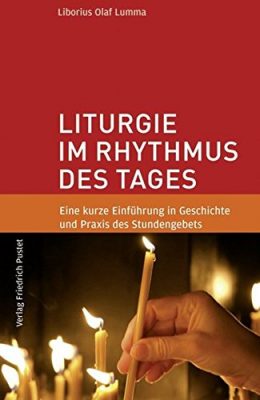
My basic idea is that one can understand the (Roman Catholic) Office best with a quadruple approach:
- the categories of monastic and cathedral office, which are helpful for understanding the deeper meaning of certain liturgical elements;
- a historical overview over the developments mainly in the Latin world;
- impressions of different ritual styles that the Office can adopt (mainly its esthetic abundance in Anglican and Byzantine traditions is very little known here);
- an idea how Catholic Office could look like if Catholics spent some effort on it.
So here is a look at the eleven chapters of the book, mirroring the academic course:
- Anthropological and Biblical basics: prayer as a natural expression of religion — the value of words in the Biblical approach to humanity and prayer — prayer gestures in the Bible — directed time: from past to future — circular time: year, (month,) week, day (and night), hour, breath.
- Monastic approach: monasticism in ancient times — tension between monasticism and ordained offices — special role of the Bible, mainly the Psalter in monastic spirituality — John Cassian’s depiction of monastic Office in Egypt — continuous reading of the psalms (and the spiritual attitude behind).
- Cathedral and mixed approaches: Apostolic Constitutions as an example for the Office in urban congregations — Egeria’s depiction of public Office in Jerusalem (times and elements; relation between Liturgy of the Hours and Eucharist).
- Development in Latin monasticism: Rule of the Master (here I introduce the entire Latin terminology) — Rule of St. Benedict as a pattern that contains all elements that we need for the following history up to Catholic liturgy today.
- Overview up to the 20th century: Latin liturgy gets more and more focused on the role of the clerics and on the Mass, even in monasteries — Office turns more and more into a private prayer by clerics, independent from the real course of time — Angelus and rosary become regular prayers for laypeople — Council of Trent and the Breviary Romanum — Reform of the Breviary by Pius X. (within the context of pleas for reform since the 19th century).
- Second Vatican Council: Sacrosanctum Concilium 83—101, its theological teaching on the Office and its concrete reform policy — Liturgia Horarum, its features and peculiarities (such as the four-week psalter, the reformed Vespers as the most popular hour, the Office of Readings, the introduction of the vernacular (German Stundenbuch) etc.) — my opinion on pros and cons of the Liturgia Horarum.
- The human body in prayer: singing the psalms in Gregorian Chant — other musical options — postures and gestures — how to celebrate the Office in rooms of different sizes: pros and cons, from large church buildings to chair cycles.
- Some leitmotifs of the Office: Light (lucernar and why it deserves to be rediscovered) — night — sleep.
- Non-Roman liturgies (mainly Vespers): Lutheran — Anglican — Old Catholic — Byzantine — Coptic — Ecumenical (I follow sources like Anglican Books of Common Prayer etc.).
- Option for the present time (this chapter contains a lot of small paragraphs with references to German publications, personal ideas and experiences with the official Catholic Liturgia Horarum and with proposals to make the Office either more monastic or more cathedral).
- Closing remarks: Some quotes from the Council, from the General Instruction on the LoTH, and from liturgists.
In addition I established a website with videos and audios from Office liturgies. Of course this website cannot substitute the personal experience, but it is a helpful tool to give some impressions.
Please leave a reply.