
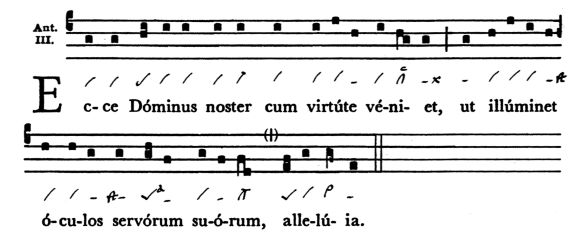
Ecce Dominus noster cum virtute veniet, ut illuminet oculos servorum suorum, alleluia.
“Behold, our Lord will come with power, so that the eyes of his servants may be enlightened, hallelujah!” (cf. Is 35:4–5)
Due to the blessing of the candles and the entrance procession, the beginning of this day’s Mass is a bit different from usual days. The Gregorian Chant knows several short antiphons and verses before the regular introit, and this is the very first of them.
It is a nice example to understand how thoroughly Gregorian Chant deals with language and the meaning of words. Just have a look at the first half:
After Dominus noster the regular stream of speech pauses for a moment (made visible by the episem, the short slash at the upper end of the neume. The effect is similar to a colon or a raising of the voice: “Behold, the Lord…” – there is tension, something important is about to come. What does this Lord do? “He comes with power,” and at the stressed syllable of vir-tú-te the melody eventually reaches its highest note by raising a semitone after the previous recitation.
This antiphon celebrates the Lord’s power. This is not self-evident at all: The biblical story behind the feast is that of a helpless, 40-days-old child that needs to be ritually sacrificed according to the law. Little infant Jeshuah is coming to the Temple – and the Christian liturgy sings of a Lord coming in power to illuminate his servants.
Could there be a more provocative challenge to our human idea of power?
Please leave a reply.