
By what metric or metrics do we measure a liturgical reform? Is historical precedent the only or primary means of doing so? Since we know that there has been a great deal of diversity in liturgical expression over various times and places in the history of the church, what time and place do we choose to model? How much scholarship is enough in order to be confident that we have understood a particular liturgical expression correctly? If we subsequently learn that a liturgical change was based on incomplete or inaccurate scholarship, do we deem said change to be inadequate? These were some of the questions that were asked during a session examining liturgical reform/renewal at a recent conference that I attended.
The conference to which I refer was the first international conference of Orthodox Christian theologians (IOTA – International Orthodox Theological Association) held this past January in Iasi, Romania. It drew approximately 300 scholars from 40 countries to discuss and debate Orthodox theology from a variety of perspectives, including (as I noted above) the liturgical expression of the Orthodox Church.
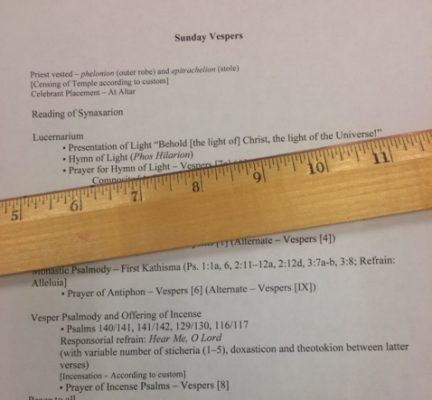
One of the speakers presented a paper critiquing a change to the structure of Vespers made by a monastery in the United States known for their liturgical reform efforts, in particular the movement of the light ritual from its place in the received tradition to the beginning of the service. (In the interests of full disclosure, the liturgical life of this monastery just happened to be the topic of my dissertation research so I was quite familiar with the liturgical expression of the community and their reform efforts.) For those of you who may not be familiar with the Byzantine rite, it has a long history of mixing what have traditionally been called “cathedral” and “monastic” elements in its practice. In antiquity, the Vespers of the Cathedral of Hagia Sophia (known as the Sung or Asmaticos Office) had a three-part structure. The first part was an office of (mostly) variable psalmody punctuated by refrains sung by the assembly in the narthex of the church (i.e. the Office of Eight Antiphons). The second part began with the presentation of light (while still in the narthex), an entrance into the nave (with a censing of the space accompanied by the lighting of the lamps), and included fixed psalmody with refrains followed by litanies and prayers for the catechumens, faithful and the world. The third part was a processional appendix with dismissal. Today, the received office of Vespers in the Byzantine rite has retained many elements from this Cathedral tradition (including the use of light, rite of entrance, fixed vesperal psalmody, evening incense and supplication) as well as elements from the monastic tradition of Palestine (e.g. the course reading from the Psalter, the singing of the Hymn of Light—Phos Hilaron, Prayer of Simeon) within a structure that has been heavily influenced by the Monastery of St. Sabbas in Palestine. The combination of the two traditions into one service has resulted in a number of elements that have been “displaced” from their original place and function. Today, the “lighting of the lamps” (i.e. Lucenarium) is found approximately half way through the service after an extended section of psalmody from both the monastic and cathedral traditions, the latter of which is punctuated by a significant amount of hymnody. The monastery in question has moved the light ritual to the beginning of Vespers in their local practice (after a short office of monastic psalmody), citing the scholarship of the distinguished Russian liturgiologists A. Dmitrievskii and Nicholas Uspensky who note that the presentation of the light opened the main part of Vespers in Hagia Sophia. However, the presenter at this conference argued that the placement of the light “ritual” within the received tradition is correct, based on its original placement after the cathedral psalmody of Hagia Sophia and that those who have judged this change to be preferable have not taken this historical usage into account.
Behold Christ, the Light of the Universe! …
“[Proclaiming this with the presentation of the light] helps to magnify the theme of light [as one of the main theological themes of Vespers]. As darkness is falling on us in the physical world, it brings new light and life into our midst. Christ is still in our midst. It is the light that knows no setting.”
Even if the my attempt to describe the complexities of Byzantine vespers has left you scratching your head, the point is that, from the perspective of the speaker, this simple change to the structure of the service has been based on incomplete or inaccurate scholarship or the understanding thereof. However, does this settle the question? For instance, do the monastery and the speaker share the same perspective or criteria for liturgical reform? As indicated above, the received rite of Byzantine Vespers includes a number of displacements. For instance, the beginning of the service now includes most of the prayers of the service from Cathedral tradition (now found in one large grouping), an opening litany that was formerly placed towards the end of the service in the cathedral rite as well as a combination of both monastic and cathedral psalmody. Is measuring a liturgical change based on only one of these aspects (i.e. a light ritual after the psalmody of Hagia Sophia) definitive? What about the Jerusalem tradition as witnessed by Egeria that places the light ritual before the cathedral psalmody? Can an appeal to liturgical history solve this dilemma? Certainly, any liturgical reform(s) should take history into consideration and be in conversation with the larger tradition of the church, in this case the Byzantine Tradition. But is this the only metric that determines a certain liturgical change and its efficacy? What about a change that emphasizes a theological or thematic point or one that responds to a pastoral need? All of these metrics are both valid considerations and have been the catalyst for liturgical reform within the history of the Church. How, then, does one decide? In this case, one of the members of the monastic community explains the efficacy of opening Vespers with the presentation of light, exclaiming, “Behold Christ, the Light of the Universe! She says, “It helps to magnify the theme of light [as one of the main theological themes of Vespers]. As darkness is falling on us in the physical world, it brings new light and life into our midst. Christ is still in our midst. It is the light that knows no setting.”
Please leave a reply.