
by Gordon Truitt
 When he took on the job of serving as president of the National Association of Pastoral Musicians (NPM), Monsignor Rick Hilgartner described his hope “that not only will the Association continue to be a valuable source of encouragement, enrichment, fellowship, and witness for us who are within it, as we strive to serve the Church and its worship . . . , but that the Association will also be the organization that supports the music of the Church in the United States, advocating for best practices across the broad spectrum of experiences of worship.” The papal Masses, as Pope Francis visits the United States this week, will be both a test of that hope and a proof of its promise.
The coordinators for music and choir directors at all three stops are among NPM’s leaders.
Tom Stehle (Washington, DC) has served on the Association’s Board of Directors; Dr. Jennifer Pascual (New York) is currently a Board member; and David Kimock (Philadelphia) is a member of NPM’s Director of Music Ministries Division – its division for professional pastoral musicians. Many members of the Association – salaried musicians in parishes as well as volunteer choir members, cantors, and instrumentalists – are serving in the choirs and in other capacities for the Masses and other services in which Pope Francis will participate.
And Mr. Peter Maher, of the NPM National Staff, is serving as the “electronic master of ceremonies” for the Mass at The Catholic University of America, directing sound and cameras so that the unfolding Mass may be visible and audible to all participants as well as to those watching through broadcast media.
Music for a parish Sunday Mass may be chosen by the parish director of music ministries, sometimes in association with the pastor, but choosing and commissioning music for Masses and other services with a pope requires marathon planning sessions that involve the Holy See, the United States Conference of Catholic Bishops, and the local ordinary – in this instance, two cardinals and an archbishop, all with very clear ideas of how the music should serve the ritual.
 In each case, the music has been selected with a nod to the Second Vatican Council’s liturgical principle of full participation by all, expressed in terms of music by NPM’s founder, Father Virgil Funk, this way: “A pastoral musician loves the sound of a singing congregation, voices raised in praise of God, above all other sounds.”
Dr. Pascual echoed that goal for the papal Mass in New York by observing that most of the music should be familiar to the worshipers and encourage participation. “I’m trying to make it as congregational-friendly as possible,” she said.
Mr. Stehle noted that, for the Mass in Washington, Cardinal Wuerl wanted the choir to “represent parish music ministry from every region and at the highest level, rather than simply a choir of the best professional singers in the region . . . . He hoped that when the gathered assembly experienced and looked at the choir, they would see themselves well represented.” Stehle described the hope that in the music of the Mass, “everyone who gathers for the Mass is able to find a genuine invitation to pray that leads to his or her active participation.”
NPM members have also been involved in composing much of the music to be used for the papal services, including some newly commissioned works.
Father Anthony Ruff, OSB, another member of the NPM Board of Directors, recently noted on Pray Tell that he composed a psalm setting for the Liturgy of the Hours to be prayed by Pope Francis and the bishops at Washington’s Cathedral of St. Matthew the Apostle, and Frank Klose has posted the list of music for the World Meeting of Families Mass in Philadelphia. That list includes compositions by NPM members Rev. Dr. J. Michael Joncas (“Exultate Justi”), Michel Guimont—honored this year as NPM’s Pastoral Musician of the Year (“Responsorial Psalm 19”), Rev. James Chepponis (Festival Alleluia”), Dr. Richard Gibala (setting of the Universal Prayer), Normand Gouin (“Mass of Saints Peter and Paul” and “Sound the Bell of Holy Freedom”), and the late Richard Proulx (“I Received the Living God”).
Tony Alonso, a doctoral student at Atlanta’s Emory University, has composed Responsorial Psalm 96 for the Mass in Washington, and Luke Mayernik has composed a new arrangement of “Pescador de Hombres”/”Lord, When You Came to the Seashore” for the Mass at Madison Square Garden. Music by Paul French (“A Prayer of St. Patrick”) will also be used in New York.
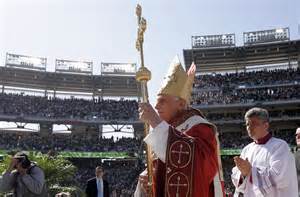 When he left Nationals Stadium in Washington, DC, after celebrating Mass there in 2008, Pope Benedict XVI commented: “That was true prayer.” Let’s hope that the forty years of work that NPM has put into building pastoral music in the United States may inspire the same comment from Pope Francis after each of the Masses and other services he celebrates this week.
By the way, both Tom Stehle and Jennifer Pascual have articles about planning for papal Masses in the September issue of Pastoral Music.
Dr. Gordon E. Truitt is Senior Editor at the National Association of Pastoral Musicians.
Please leave a reply.