
Liturgical Schedule of Pope Francis’ Visit to the United States

The USCCB has announced the schedule for Pope Francis’ visit to the U.S. With further information from the June issue of theย Newsletter of the USCCB Committe on Divine Worship, the liturgical schedule looks like this:

Wednesday, September 23, 11:30 am: Midday Prayer with the US bishops at St. Matthew’s Cathedral in Washington, DC. From the Liturgy of the Hours, predominantly in English with intro and conclusion in Latin. The pope will give a homily after the reading.

Wednesday, September 23, 4:15 pm: Mass of canonization of Junipero Serra at the east portico of the Basilica of the National Shrine in Washington, DC. Votive Mass in honor of the newly canonized. Most of Mass in Spanish, with homily of pope in both Spanish and English. One Scripture reading in Native American language close to what was spoken by some of the Native Americans evangelized by Blessed Junipero.

Thursday, September 24, 6:45 pm: Evening Prayer with priests and religious, St. Patrick’s Cathedral, New York City. Vespers of day in English, Spanish, and Latin, with homily of the pope after the reading. Responsory replaced by Mozart’sย Laudate Dominum sung by cathedral choir.

Friday, September 25, 11:30 am: Interreligious Prayer Service with prayers for peace in multiple languages from Hindu, Buddhist, Sikh, Christian, and Muslim traditions. Jewish Kaddish sung, and a choral piece by Leonard Berstein and Stephen Sondheim. The service will include the prayer of remembrance first used by Pope Benedict XVI at Ground Zero in April, 2008.

Friday, September 25, 6:00 pm: Mass for Preservation of Peace and Justice, Madison Square Garden, New York City. Classical and modern pieces in a variety of languages. Readings in Spanish and English, with Eucharistic Prayer II in Latin.

Saturday, September 26, 10:30 am: Votive Mass of Our Lady, Mother of the Church at Cathedral Basilica of Ss. Peter and Paul, Philadelphia. Readings in Spanish and English, Eucharistic Prayer I in Latin. (And see below.)

Sunday, September 27, 4:00 pm:ย Concluding Mass of World Meeting of Families, Benjamin Franklin Parkway, Philadelphia. Readings in Vietnamese, Spanish, and English.ย Gloria,ย Creed, and Eucharistic Prayer III in Latin.

Note that at the Mass on Saturday the recessional hymn will be the official song of the 2015 World Meeting of Families, “Sound the Bell of Holy Freedom”:
Editor

Katharine E. Harmon, Ph.D., edits the blog, Pray Tell: Worship, Wit & Wisdom.

Please leave a reply.

Comments

20 responses to “Liturgical Schedule of Pope Francis’ Visit to the United States”

  1. Steven Surrency

    I wouldn’t have expected so much Latin. Not sure if it means anything. Definitely less Latin than Benedict used, but I think more than JP (I’m not sure on that.).

  2. Charles Kramer

    My understanding is that Francis, unlike John Paul and Benedict, is not very comfortable in English. Latin is probably a good alternative for him.

    1. Elisabeth Ahn

      @Charles Kramer:

      Exactly.

      Pope Francis has always done this when visiting countries whose official languages he doesn’t speak comfortably, e.g., Korea, the Philippines, Bosnia-Hercegovina, Turkey, etc.

      By comparison, in Brazil, he used Portuguese and in the three Latin American countries, Spanish (obviously).

      It seems to me that these decisions are made for practical, rather than liturgical, reasons, and also, on account of not so much “what’s better for the Pope” as what’s better for the people.

      Which is to say I think Pope Francis would rather exclude everyone by using Latin than include some but not others by using Spanish ๐Ÿ™‚

      1. Agman Austerhauser

        @Elisabeth Ahn:
        Or you could say these decisions were made for practical liturgical reasons… not “practical rather than liturgical reasons.”

        Oftentimes, liturgical choices are made based on practicality.

        Latin doesn’t have to exclude everyone. Get practicing! ๐Ÿ™‚

  3. Fr. Jack Feehily

    Spanish would make more sense than Latin if it’s based on what’s better for the Pope. I’m wondering if this might mean that Francis has not been well briefed on the topic of “liturgy wars” in the US. Just saying.

  4. Jonathan Ziegler

    I’m interested in learning more about the Scripture reading in a “Native American language close to what was spoken by some of the Native Americans evangelized by Blessed Junipero.”

    Which language exactly will it be? I assume the reason they won’t use an actual language spoken by those evangelised is because they are presumably extinct – a result of the missionary activity of Serra. Does the substitution of some other Native American language imply that they are interchangeable for the purposes of tokenism?

  5. Sean Whelan

    Any word on the Mass settings being used?

  6. Steven Surrency

    I agree with everything above. I do note that even in Latin America he sometimes used Latin and said the EP in Latin. I wonder how these decisions are made.

  7. Karl Liam Saur

    He or his staff may have been advised that sticking to Spanish in the US might have a political significance not necessarily intended.

  8. Jeffrey Maurer

    Strange song…why not just sing songs people know for the recessional rather than these ad hoc convocation hymns.

  9. fred moleck

    Hello. You should know that the text was written by Fr. Andrew Ciferni and the music written by Normand Joseph Gouin both of them who have some connections to Daylesford Abbey. Mr Gouin headed all of the music ministires at Old St.Joseph’s RC Church in Philadelpia and is of the ministers at a Roman Catholic College. His music is growing in popularity amongst informed Roman Catholic Music ministers. We hope and pray the American Church should be blessed with another dozen of Fr Cifernis and Mr. Gouins…..please God.

    fred moleck

  10. I’m surprised they’re using EP II rather than one of the V Eucharistic Prayers that go with the Peace and Justice propers.

  11. Steven Surrency

    I note the temptation in various blogs (and in myself) to interpret Francis’s liturgical choices as opportunities to reinforce one’s own liturgical taste. “See, he uses Latin.” “Did you hear that contemporary music?” Some like to simply dismiss his liturgical choices: “He must not know that…” “He is a Jesuit, so he doesn’t care…” But I don’t buy any of that. I think he is involved and aware of the choices he is making, not every little choice but at least many of them.

    Taken as a whole, it seems to me that Francis’s liturgical emphasis is something of a middle way between experimentation and rigidity. A via media between tradition and novelty. He is no “progressive modernist” nor a “hypertraditionalist.” I just wish there were some commentary to go along with the choices. Does he use Latin and chant as model of good liturgy, or simply of good “papal” liturgy? Are the antiphons chanted because they should be the norm, or just the norm in big, Latin masses? Does he use more contemporary hymnody as a concession or as a standard? Marini used to explain the rational behind Benedict’s choices. I don’t see that so much under Francis.

    1. Elisabeth Ahn

      @Steven Surrency:

      ” I think he is involved and aware of the choices he is making, not every little choice but at least many of them…. I just wish there were some commentary to go along with the choices… Marini used to explain the rational behind Benedictโ€™s choices. I donโ€™t see that so much under Francis.”

      Me too; me too; yes, he did!; and me, either, which is kinda curious, no?

      Perhaps Monsignor Marini is busy with other things these days. This past spring, I was at St. Peter’s square for the Sunday Angelus, and it was one of those lucky days when the Pope handed out free pocket-sized Gospels to those at the square.

      I stationed myself right outside the cordoned-off area, from which the poor, led by the Pope’s almoner, Abp. Krajewski, and other volunteers, sisters and priests, were to distribute the gospels. And there, I saw Monsignor Marini standing among them, chatting and laughing away with the lot of them.

      This surprised me a bit because — and this may very well be my own bias –Marini never came across as someone who did this kind of thing, you know, mingling among the poor. No matter, it was great to see him there, like that.

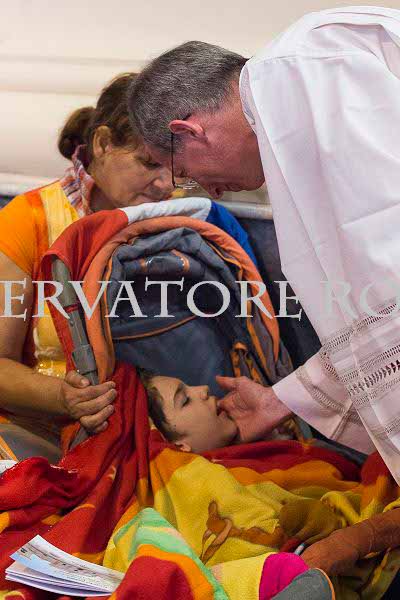
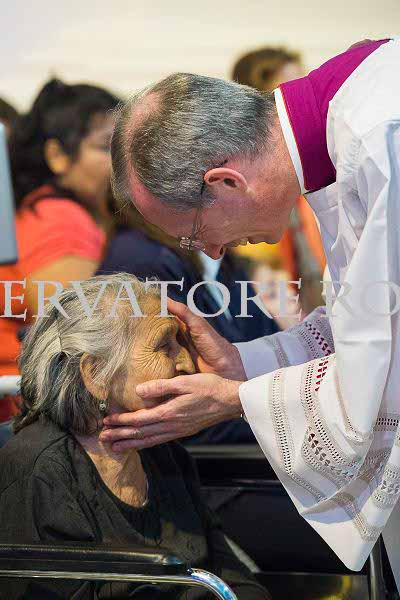
      Likewise, while perusing the photos from the Pope’s trip to Latin America, I encountered these (hope the links go through!):

      http://www.photovat.com/PHOTOVAT/FRANCESCO/2015/7.LUGLIO/10072015_PARAGUAY/11072015_PARAGUAY-56-CATTEDRALE/content/bin/images/large/28106_11072015.jpg

      http://www.photovat.com/PHOTOVAT/FRANCESCO/2015/7.LUGLIO/10072015_PARAGUAY/11072015_PARAGUAY-56-CATTEDRALE/content/bin/images/large/28107_11072015.jpg

      Could this be the Francis Effect? ๐Ÿ˜€ Maybe so; maybe not. Maybe he’s always been this way, and I just never knew about it.

      Anyway, it’s clear that he and the Pope don’t share the same liturgical proclivities, but it seems just as clear how well they are getting along now, liturgically and otherwise, and I too wish he would share some insights into the Pope’s liturgical…

      1. Gerard Flynn

        @Elisabeth Ahn:
        Elizabeth, 1+++. Thank you for the links.

    2. Sean Whelan

      @Steven Surrency:

      I think this was in part, fairly well inferenced here already – the choice of Latin is not throwing a bone to the traditionalists, rather it’s a practical need due to the pope’s lack of fluency in English. Though one would think he’s smart enough to get Eucharistic Prayer II rehearsed enough to pray it in English.

  12. Carlos Antonio Palad

    To those commenting on the Pope’s use of Latin and English:

    I live in Metropolitan Manila and as most of you know the Pope visited the Philippines earlier this year. The Pope was reported to have put much practice into speaking in English, but in the end he 1) often set aside his official speech in order to speak off-the-cuff in Spanish, with a monsignor at his side providing a quick translation, and 2) said much of his Mass in Latin, even the portions he was supposed to say in English. When he did speak in English, his articulation was (understandably) poor and very hard to catch; those watching him on television or the Internet probably understood him better than those actually in attendance at his Masses and events. Therefore no one objected when he said most of his Mass parts in Latin; everyone understood that it was easier for him, and easier for the congregation — not because the congregation understood Latin, but because it was not easy to see him struggling with having to speak in English.

  13. Roger Stratton

    Unfortunately, the hymn title sounds like a dog-whistle to the “fortnight” folks. Please tell me I’m paranoid.

  14. Rod Hall

    With all due respect, I think it perfectly understandable that the Holy Father would opt to default to a language with which he is more comfortable at these massive gatherings. It is awkward in the extreme to be in the train of proclaiming a liturgical text and lose the rhythm of the language and be reduced to plodding through a text. For a native speaker to stumble over a word or turn of phrase and then recover and resume the proper cadence can be a challenge. But in the absence of any sense of familiarity with the text or facility for the language?

    The current liturgical texts are ponderous — and a challenge to proclaim — when you know the language as your native tongue. For those for whom English is a second or subsequent language, it requires yet greater effort to render the texts proclaimed, if nothing else, minimally disharmonious. When one really has only the most uncomfortable grasp of the language? It would be beyond daunting.

    As but one example, the first sentence in Eucharistic Prayer III is an unbelievable 72 words long. It takes skill to raise and lower the pitch, strategically pause, and inflect the voice so that this cascade of words has some cohesion — not to say coherence — and does not become, simply, 72 words strung back to back.

  15. Ed Nash

    What Fred said #11…

    It is a reminder that names, education and effort are behind each song we sing.

    I also think that Pope has much less of a choice of music, song texts, and prayers than we give him credit. So many people have their hands in these celebrations and liturgies. And I hope that if he goes off script, it will be in a language he knows so we can get the full flavor of what he wants us to hear. Thank you for the insights Carlos #17.


Posted

in

by

Tags:

Discover more from Home

Subscribe now to keep reading and get access to the full archive.

Continue reading