
I’m recently returned from a full month in Europe, two weeks in Slovenia (about which, the present post) and two in France (about which, my next post in the coming days).
After a first week making my annual silent Ignatian retreat in the Slovenian Alps, I spent the second as the guest of the Jesuit Community in the heart of the capital city, Ljubljana. The local superior, Fr. Damjan Ristic, SJ, kindly invited me to preach the homily at the Sunday Mass of the local English-speaking community he founded several years ago. Two things from that morning and, indeed, my entire stay, struck me as worth sharing with Pray Tell readers: liturgical music and liturgical space (architecture, art, design).
The music, which was led by a small volunteer ensemble of voices, electric piano, and guitar, was almost entirely in the genre of “praise music,” taken from the repertoire of Hillsong and similar groups. As people gradually entered the moderate-sized St. Mary Chapel (situated off the immense main sanctuary of the Jesuits’ Saint Joseph Church), the ensemble rehearsed music for the liturgy. Fr. Damjan, showing pastoral wisdom, explained that he works with the character of the assembly and their musical preferences, such as these emerge each year in this small community, whose membership (students, foreign ambassadors, entrepreneurs, and others) shifts and reconstitutes itself annually.
I was not entirely surprised to witness the young-to-early-middle-aged community’s enthusiasm for non-denominational praise music, as I had witnessed the same six years earlier during a Mass at the Jesuit church in Bratislava, Slovakia. In the latter case, however, the music ministers were native Slovakians, not expats. I am incapable of offering any solid commentary about this Eastern European ecclesial-cultural fact, that is, the affinity of both foreign and local Roman Catholics for the praise music genre. I certainly would be interested in similar reports or any observations from the Pray Tell readership.
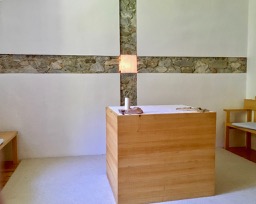
Returning to that Slovenian Sunday morning: The liturgy seemed rather reminiscent of the twentieth-century “four-hymn Mass,” insofar as the music figured most prominently at those four stages of the liturgy. Only some of the integral elements of the rite, such as the gospel acclamation or Lamb of God, were sung, while others, such as the responsorial psalm and Sanctus, were not. But after the Concluding Rites the people remained in the chapel for a full half-hour to continue singing a series of praise songs. i noticed a few people also practicing the bodily gestures, actions, and acclamations typical of the Charismatic Renewal. Time seemed not to matter; indeed, the ensemble eventually repeated some songs that clearly were favorites. The words to the songs were projected high on the front wall to the right of the small sanctuary, whose light-wooden altar and ambo’s curved shapes, situated before an apse-like arch cut into the wall, softened the otherwise strongly rectangular room. This leads to the second feature of my Slovenian account: the design and artistry of the chapel spaces.
The design, art, and furnishings of the St. Mary Chapel were the work of Slovenian Jesuit Robert Dolinar, an award-winning architect for whom light is his fundamental working principle. Fr. Dolinar expounds on that point In the course of an interview about another chapel he created for Ignatius House, the Jesuit spirituality center situated alongside St. Joseph Church. During my first morning in Ljubljana, Jesuit Deacon Marko Pavlic gave me a guided visit to the chapel, explaining the distinctive features of Dolinar’s design.
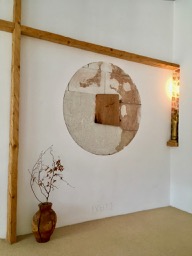
Since it is primarily a meditation chapel for people on retreat, Dolinar oriented the third-floor room toward the Blessed Sacrament, reserved in the artistically crafted right-side wall. To give the impression of movement from darkness to light, Dolinar exposed some of the raw stonework of the wall’s interior, an effect also meant to allow the “flesh” of the building to emerge. That latter principle is further evident when one opens the tabernacle, revealing more of the wall’s lighted, interior stonework.

Natural light bathes the room through windows facing onto the street, while a recessed lighting fixture is situated in the ceiling between the altar and tabernacle.


The top surface of the ambo (flat, so as to require the reader to pick up the lectionary) is coated with a paint mixture of materials (natural and manmade) from the local environs and inscribed with the word “logos,” while the thickly coated altar has sheaves of wheat etched into its bottom corner. Timber is a fundamental resource, both economic and cultural, in Slovenia, and Dolinar has featured it throughout the chapel–its furniture, doors, and other accessories.


Dolinar sculpts wood using a chain saw. In addition to the furnishings, the Ignatius House chapel includes not only the framing of the Blessed Sacrament ensemble but also, across the room on the opposite wall, the sculpture of a rustic loaf of bread. His writing into the wall surface above the sculpture (“Take, Lord, receive,” from Ignatius’s Spiritual Exercises) is another characteristic design feature–one that Dolinar likewise utilized next to the chapel’s entry door in the hallway.


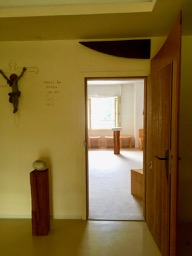
The sisters who own and operate the Alpine retreat house where I spent my first week likewise engaged Fr. Dolinar to rework their small, intimate community chapel on the second floor. The left photo below gives evidence of design principles resonant with those of the Ignatius House chapel: exposure of one wall’s interior stonework, reservation of the Blessed Sacrament deep within the “flesh” of the wall, furnishings made of local timber (plus sparingly selected words inscribed in the wall near the door). The right photo is of the sisters’ large, red-roofed house, Logarska Dolina.

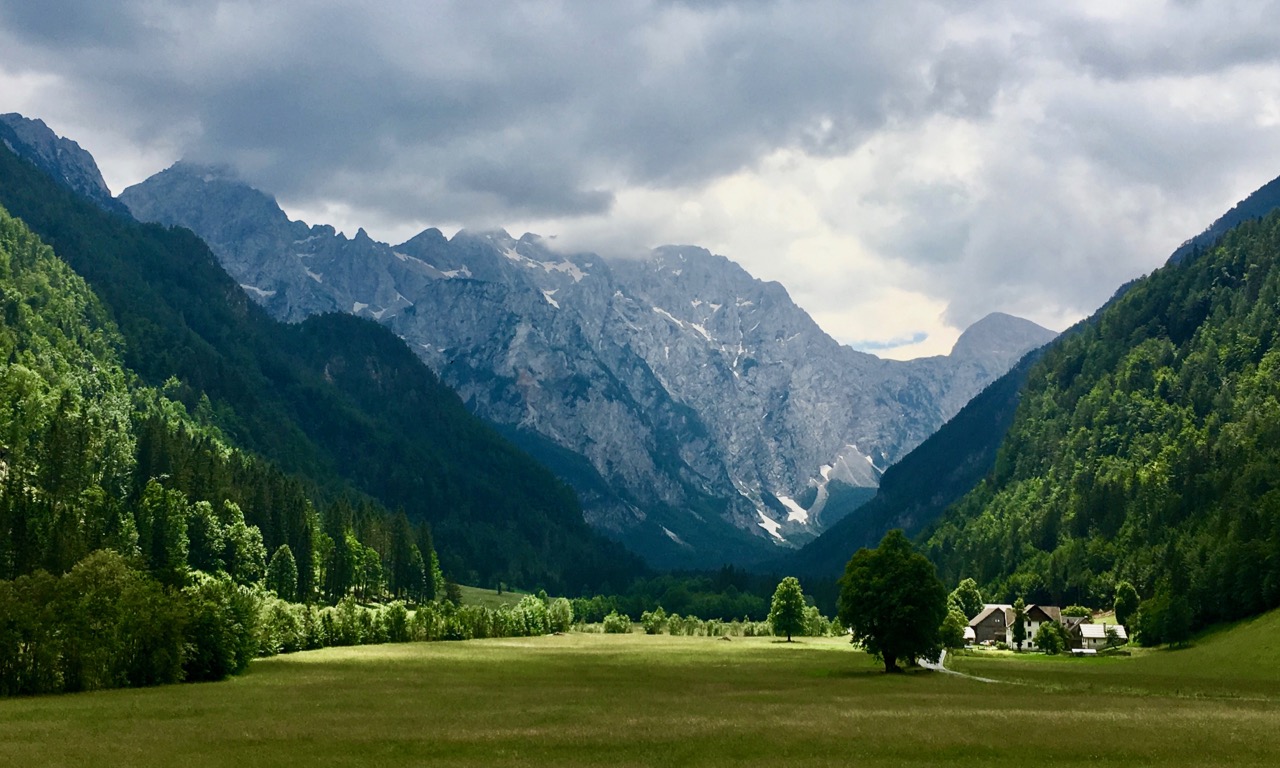
I cannot resist closing with a shot of the view from the balcony in front of my bedroom, looking up the Logar Valley toward the Alps, the late-afternoon sunshine breaking through rain clouds. Given a few weeks’ time and distance now, I can muse that such native landscapes may well have helped shape Fr. Dolinar’s architectural design principles.
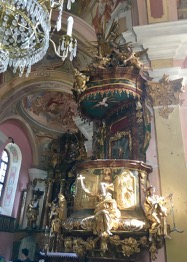
And that closing reflection leads to yet one further memory, my being taken for a tour of a Baroque masterpiece of a church in the eastern Slovenian countryside, the Pilgrim Church of Our Lady in Sladka Gora. These two photos that I took of the pulpit provide further examples of light as an integral principle for church design in the cultural-historical environment of the Slovenian Jesuit architect whose own work seeks to foster prayer and worship for our present time.


Please leave a reply.