


In recent years the English industrial designer Sebasitan Bergne has made a splash with his reductive Colour Nativity. The first presentation was a large scale installation in 2013 commissioned for the Chapel of the Royal Naval College in Greenwich, UK. Subsequently the Colour Nativity was included in the permanent collection of the museum, Les Arts Décoratifs, Paris (2017). In all things commercial and design you can now purchase your own Colour Nativity for £110 – so much for winning back the service of artists in Christian religion, unless their wallet and fame is included. I dare say without the original Neo-Classical juxtaposition of the Naval College that made the first appearance of Bergne’s nativity in 2013 at least interesting, the infantile colour blocks are unlikely to have the same effect in the suburbanite home. Indeed, even more off-putting simulacritude have been placed in English Cathedrals evoking the aura of tomb-like monuments sealing the fate of ecclesiastical relevance seekers.

I mean, of course, to be a bit tongue-in-cheek. But just a bit. Spirituality in art can be a shifting-sand discourse, but the faceless and shapeless Colour Nativity has been a point of Advent reflection for me. Karl Rahner in Encounters with Silence (1960) wondered, “Are You [God] the eternal Advent? […] Are You only the distant horizon surrounding the world of our deeds and sufferings, the horizon which, no matter where we roam, is always just as far away?” (80). In short, has God revealed God’s self, or is God a faceless mystery, or worse, a self-centric projection? Rahner answers, “You, the hidden God, have been found as one of us. You have quietly and inconspicuously taken Your place in our ranks and marched along with us” (81). God not only has a name, but in Christ Jesus has a face. At least in Eastern Christianity this fact has incisively shaped liturgical art. The art of faith, and the Incarnation, is not a ubiquitous fill-in-the-blank as Bergne would seem to have it. Don’t get me wrong, I get contemporary art’s obsession with self-exploration, projection, and the like, and to an extent I have argued for an inclusive vision of liturgical art that welcomes such exploration within certain boundaries. But I can’t get past the feeling that Advent is a time of icons—and this fact says something about the nature of liturgical art definitively.

Icons therefore are not aesthetic objects at which we look, but modalities of incarnation by which we encounter the divine in human realities. To this extent they are liturgical par excellence. The liturgy and image effect the same encounter in parallel manner. Icons are extensions of Christ being enfleshed and therefore their whole nature is one of encounter with the God who is present, the God who is fragile, the God who must be received (See, Bernard Ugeux, Traverser nos fragilités, CERF, 2012). Icons demand that we not approach them with our expectations and experiments, but rather with our fragility and submission by which we experience our own impotence and dependence. Icons invite us to approach the mystery of faith with incarnational obeisance, to render ourselves vulnerable to the fragility of God, just as the Word sought a home in the Virgin.

Ironically, in the midst of our culture with its pathology for power, icons are today making a robust entrance into the Western church, liturgical practice, and spiritual imagination. A growing protagonist in this evolution is the icon writer Ian Knowles and The Bethlehem Icon Centre. While the centre is dedicated to the renewal of iconography in the Holy Land and its primary goal is to educate local Palestinian Christians in ancient art, the Centre’s work extends around the globe including both Papal and Cathedral commissions.

Ian wrote the icon of Christ the Saviour, commissioned by All Saints’ Anglican Church, Rome, for the first ever visit of the Pope of Rome to a Church of England parish community since the Reformation, held in February of 2017. Another recent commission includes a monumental Annunciation and Crucifix for Lichfield Cathedral, UK.

As Ian has noted, “Scriptures and icons are parallel ways of disclosing the mystery of Revelation, so that the icon in some way functions as does Holy Scripture…as a place of encounter between the Word of God and humankind.” This idea applied to a church building supposes that the entire building embraces the assembly in the Word of God. At the same time, the canon of iconography, although historically fixed, is not mute. Precisely because of its bearing of revelation it is able to speak anew in human history, and often in troubled contexts. In the heart of Bethlehem, at the behest of a community of religious sisters, Ian wrote onto the partition barrier between Israeli-occupied lands and Palestine, the icon of Our Lady Who Brings Down Walls; the Theotokos, pregnant and who finds no welcome in the other, waits to give birth to new hope in the face of all odds.
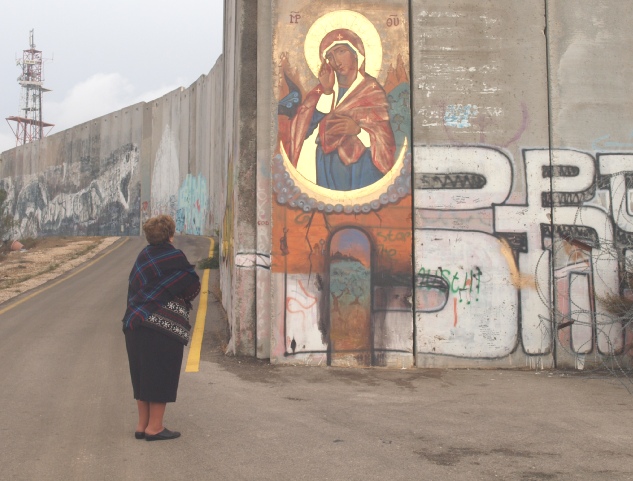
 The limits of contemporary ‘sacred’ art are found in simplification and superficiality, naïve artifices of the great figural traditions as vehicles of spiritual messages; Art characterized by research and construction born of a false desire for truth that hides its true emptiness, the absence of content, the incapacity to welcome the observer. Icons convict this shell game of modernity, being places of encounter where the mystery-ridden gaze of the holy crosses into our own world, for it is only in the face of the other that we know ourselves, and only in the face of the other, according to the Greek Fathers, does our divinization and transfiguration take place as created images of God. This image of God is indelible both in the Lord and in us. Even in the fall of humanity, the image of God is always present. The spiritual life, Origen insists, is the liberation of the face of Christ written in us.
Advent it seems to me is a time of icons – waiting for the revelation of the face of Christ both in us and in the world around us. Perhaps we need more icons in our spiritual and liturgical lives to learn to see rightly, that our eternal Advent prayers of renewal, and righteousness, and justice might be fulfilled.
You can learn more about the work of the Bethlehem Icon Centre and artist Ian Knowles here.

Please leave a reply.