

I’ve always found it ironic, if not a bit irritating, that the greatest take-away from Louis Bouyer’s short treatise on the liturgy, Liturgy and Architecture (1967), seems to be his comments regarding which direction the priest should face during the Liturgy of the Eucharist. Much more important, and much more often ignored, are Bouyer’s space-maps for the ideal celebration of the liturgy. While the historical research is imprecise, much is to be recommended regarding the suggested arrangements of Assembly, Choir, Ministers, Altar, Ambo, and Chair. To a great extent these ideas are still ignored both in renovating and building places for worship. Churches, both in interior details and architectural form, continue to be statically defined by platforms and pews. We still worship the wall.
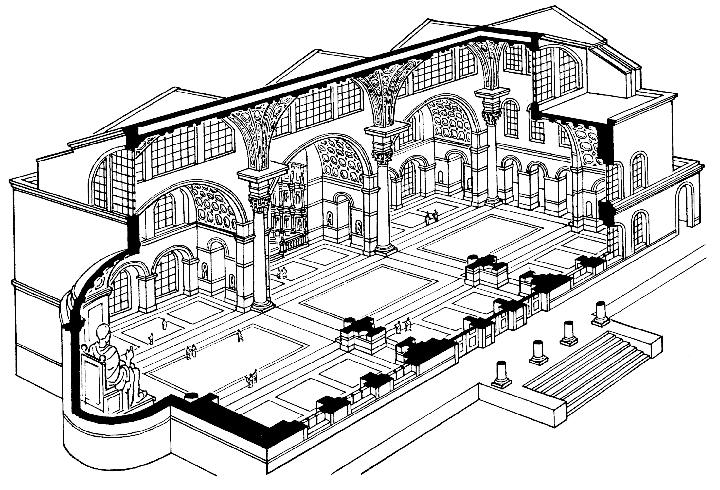
The history of liturgical art and architecture speaks eloquently of alternatives. The idea of a hierarchically arranged space along a longitudinal axis that terminated in a raised platform was inherited from Maxsentius’ basilica in the Roman Forum. While it may have been typical for Roman Christianity to use the basilica to spatially define roles of people within, it was but one possibility. The Church of East Syria thought of the interior space according to the ‘geography of salvation’ in which the building with its bema and apse moved from earth to heaven, from the incarnation to the eternal banquet. In general, Byzantine spaces emphasized pseudo-Dioynsian hierarchies through the building’s vertical axis. More specifically, Antiochene and Alexandrian theologians often thought of the spatial divisions within churches in terms of the homoousios or other Christological issues. In most cases this varying array of buildings did not physically read as static spaces directed toward a terminating platform – moreover, liturgical roles in this sense were secondary, though admittedly plenty of historical documents abound forbidding the mingling of clergy and laity.

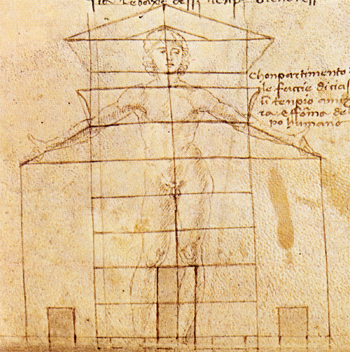
Arrangements of people and liturgical appointments varied therefore between the families. In the medieval period anthropomorphic references regarding the church building were not, as commonly thought, about Pauline issues of headship applied to liturgical roles, but anthropomorphic concepts of the universe found in the thought of such people as Hildegard of Bingen. Similar concepts of divine proportions occupied Renaissance design of the church building in the works of theologians and architects like Giorgio Martini.
If we are to find the modern precursor to staged-worship anywhere, we must look to Charles Borromeo’s Instructiones Fabricae et Supellectilis Ecclesiasticae (1577) and the Jesuits’ post-tridentine importation of Baroque spatial and decorative theory. It was in these centuries that space planning of churches included wide open halls that terminated in an elevated, balustraded sanctuary where altar, pulpits, chairs, and choir were all placed. The church became a performance hall for the dramatization of a liturgy that was directly related to the staging of opera. It is no coincidence that persons such as Gian Lorenzo Bernini, Francesco Borromini and Andrea Pozzo worked for both Church and theatre.

Historically speaking, however, churches tend to be dynamic in their arrangements. Liturgies used the space as a means of ritual and theological communication. Given this fact, the problem with pews and platforms is that they don’t simply render the assembly passive spectators, which they do, but they destroy the symbolic and trasformative potential of the space as a primary language in which rites speak.

Yet, this is precisely the problem with documents, such as the General Instruction of the Roman Missal, that dissect buildings into binary categories. The GIRM defines the sanctuary as “the place where the altar stands, where the word of God is proclaimed, and where the priest, the deacon, and the other ministers exercise their offices. It should suitably be marked off from the body of the church either by its being somewhat elevated or by a particular structure and ornamentation” (295). Such a concept is historically naïve and the product of the Baroque liturgy. It is insufficient for enabling reformed liturgies. In like manner, the Roman Catholic Archdiocese of Washington, D.C. prohibits sloped floors lest a church feel like the local mega-plex cinema. The problem of course is not the sloped floor, it’s the contraction of every liturgical point of interaction upon a platform rendering the church an auditorium by default.
If Baroque scenography helped cause this deformative dynamic, contemporary scenography and its concern to develop ‘immersive spaces’ points to new ways forward in liturgical architecture. As I have argued elsewhere, the entirety of buildings should be involved in ritual action.
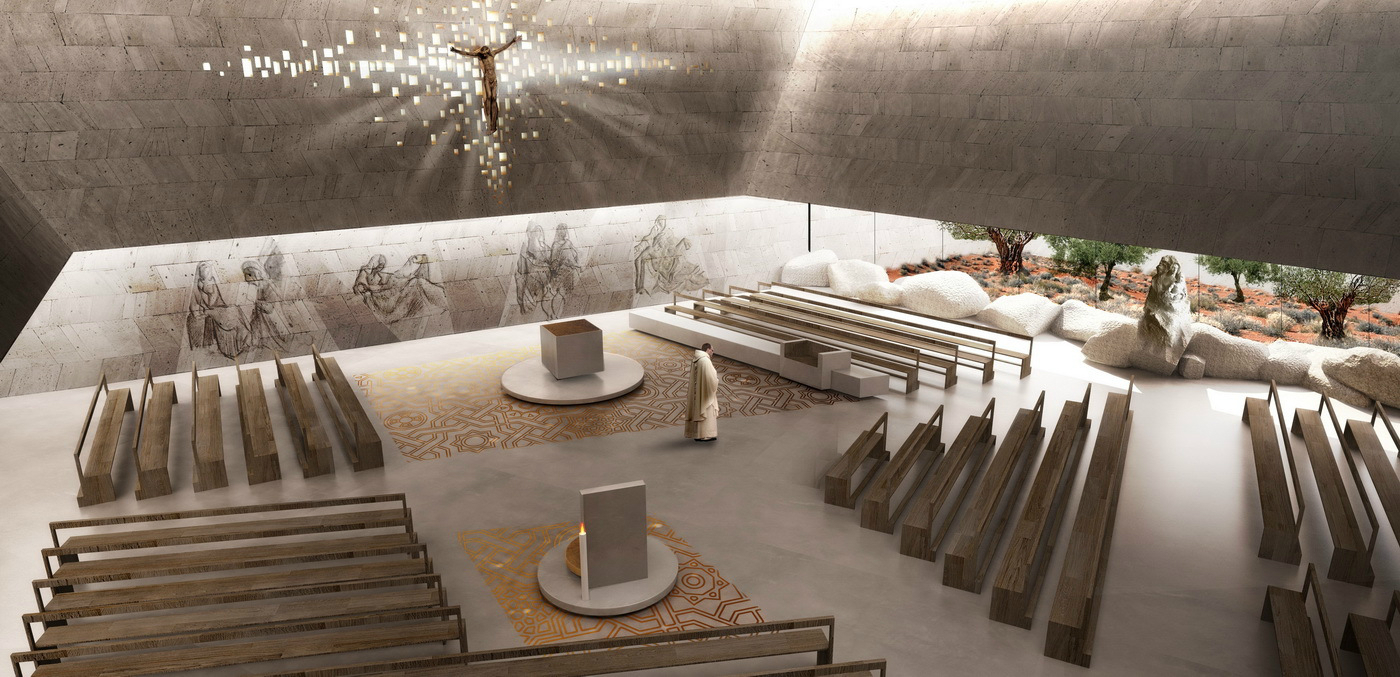
Liturgy must be spatially activated so that it takes place among the assembly, not before their eyes in some type of retrograde medieval ocular communion. A building that is immersive will allow the ritual to attain its full expressive power, not because it makes people feel like they are doing something, but because space fundamentally involves the assembly on bodily, visceral and intellectual terms. How so? The philosopher Jan Patočka in Lo Spazio e la Sua Problematica (2014) describes space as the proto-structure of relationships; The experience of space highlights mechanically the I–you complementary disparity, and in doing so effects the realization of relationships in which I am both an agent of participation and causing. Space both defines me as limited and unique but also requires me to approach another object in an act of encounter. Anything that traverses space therefore touches in a fundamental way the sense of my being since boundary moving is hardwired into the mind by the experience of life. Platforms and pews inhibit this instinctive boundary crossing.

In light of the fundamental importance of the experience of space and the diversity of ways church buildings have been conceived symbolically the notion that “the ordering of the sacred building must […] in some way convey the image of the gathered assembly” (GIRM 294) seems to be a misplaced priority in determining spatial arrangements of churches. At the least, such phrases should not be interpreted to mean rows of pews terminating in a sanctuary platform for the sake of defining groups.
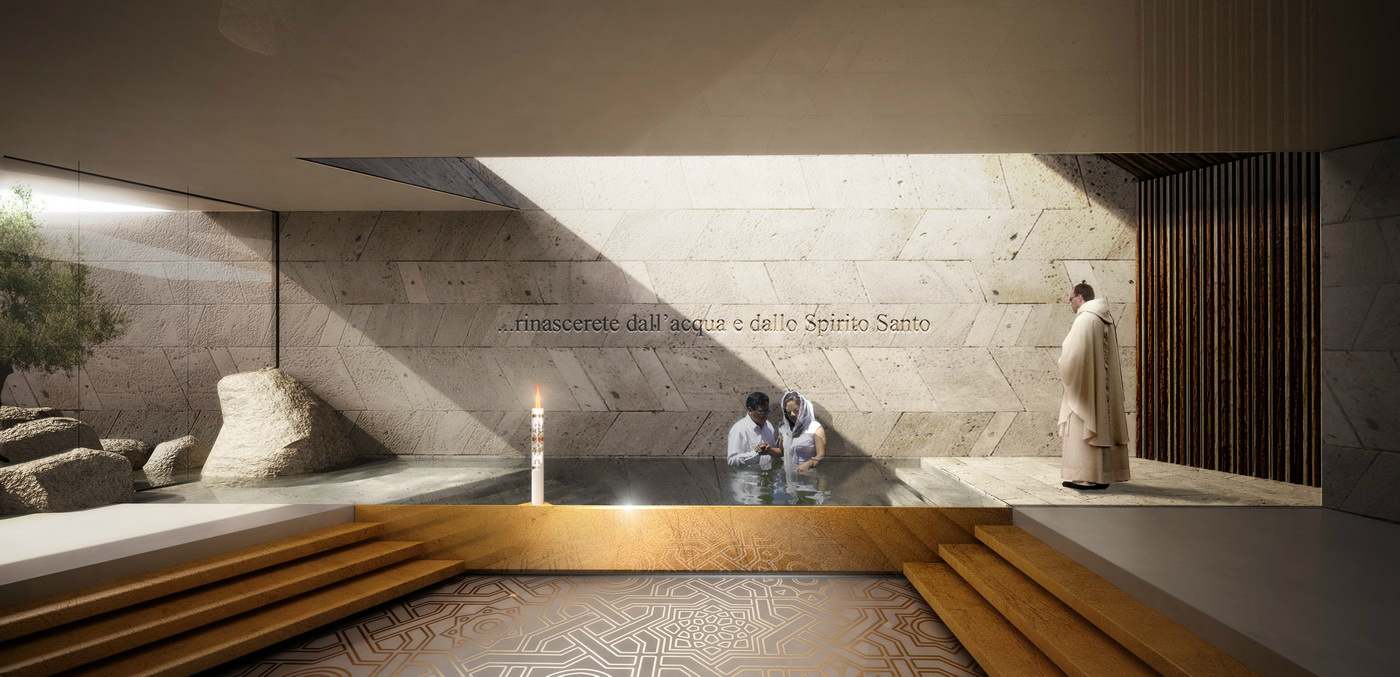
We need a new spatialization of the liturgy. We need to worship with space, not simply in space. Liturgical spaces should be designed according to poles of liturgical action that are arranged according to the logic of the rites.
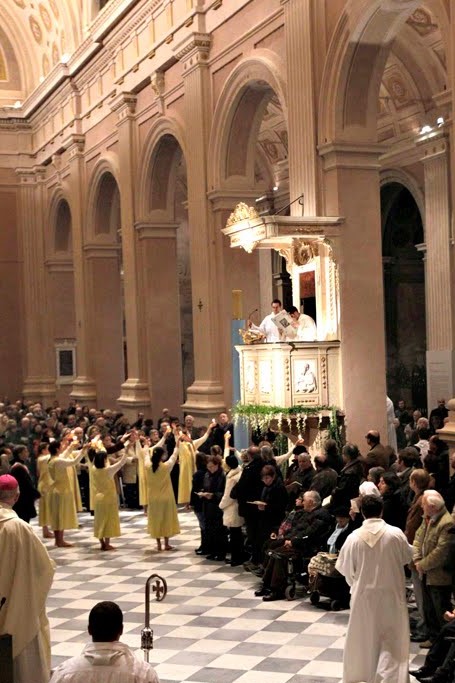
To this extent, the idea of the building as sacred geography is more apropos. The building and its art programming should comment primarily upon the nature of worship, not who is sitting where. In new buildings this is easier to accomplish. The altar, ambo, presidential chair, and baptismal pool can have their own positions that require liturgical movement and which refrain from being situated in stage-like settings.
In historical buildings this might involve using once again historic pulpits for the Liturgy of the Word and the elimination of seating arrangements that make the nave simply a holding pen. Historical preservationist tend to complain but there is no reason suitable solutions that work with the architecture and which prioritize the living liturgy cannot be found .
In the typical parish where remodeling may not be feasible or a fixed ambo is in use, the anglo-catholic practice of processing the Book of Gospels into the midst of the assembly for its proclamation is at least one way to begin to break stage-bound worship.


In many cases it would be a quick and inexpensive remodel to move the ambo to a central location simply cutting back a few pews to make adequate room. Like the painting of the catholic modernist painter Maurice Denis this arrangement speaks eloquently of the incarnation of the word in the assembly – in which the boundary between heaven and earth is ritually and sacramentally traversed.
A more radical rethinking of the spatial priorities and requirements of reformed liturgies is needed that does not simply update Baroque precedents. It’s time to end staged liturgies and seek instead a new understanding of space’s sensual-moral possibilities in the service of worship.

Please leave a reply.