
I visited an intriguing sanctuary recently: an early twelfth-century Cistertian abbey church that now serves both as the Catholic and also the Protestant church of the little town of Altenberg, in Germany. Obviously, the old Cistertian abbey church is stunning in and of itself, still marked by the reforming zeal for clarity and simplicity of its earliest worshiping community. I visited while a Catholic Mass was celebrated but knew that within hours, a Protestant community would gather in the same space to celebrate its own service, to be followed by another Catholic Mass. I wondered what the early Cistertian monks would make of their now “bi”-ritual sanctuary. It struck me that the early Cistercians share some liturgical preferences with later Protestant worshippers, not least in their architecture (it would be much harder to see a Baroque Catholic sanctuary as a naturally welcoming space for a Protestant congregation). Which leads me to wonder: where are the places where our traditions lean toward being “bi” quite naturally?
A Sanctuary that is “bi”
Comments
12 responses to “A Sanctuary that is “bi””
-
A Google search for St Andrew’s shared church, Cippenham, will show a remarkable story of co-operation between Anglicans and Catholics that continues today. Pin Green church in Stevenage started off by being shared by Anglicans, Methodists and Catholics, though the Catholics had to pull out a couple of years ago because of clergy shortage. The University of Lancaster chapel has a remarkable design with three “arms” used by different denominations converging on a central space used by all of them.
One shared church building whose name and location temporarily escape me had Anglican and Catholic churches end to end, so no common worship space but a common tabernacle between the two of them. The tabernacle was divided by a sheet of glass. The late Bishop Christopher Butler, a great ecumenist and one-time Abbot of Downside, used to say that there should be a little hammer next to it with a notice saying “In case of unity, break glass”.
These and others are all purpose-built shared churches, but there is also a considerable tradition in England of Anglicans allowing Catholics to use their churches for Mass (an interesting phenomenon in the countryside where these old churches originally were Catholic before the Reformation) and also Catholics inviting Anglicans and others to use their churches. None of this would have happened had it not been for the boost to ecumenical relationships given by the Second Vatican Council.
The church in Altenberg, known as the cathedral even though there there has never been a bishop there, is notable for the flexibility of its worship space, including two organ consoles, one with tracker action built into the organ and another moveable one with electric action which can be “plugged in” at a number of different points around the building.
-
@Paul Inwood:
I’ve been to Mass at St. Andrew’s, Cippenham, on occasions in the mid-Seventies, while visiting a nearby Anglican monastery after becoming a Catholic, and knew about the Tabernacle with the glass petition and the very quotable quote, but not that it was Bishop Butler who said it.
-
-
This is fairly common in Germanic countries.
http://en.wikipedia.org/wiki/Simultaneum
Albert Schweitzer’s father was the protestant minister in such a church at Gunsbach.-
@Alan Johnson:
Also in Alsace, on the other side of the border. St. Pierre de Vieux is a famous example in Strasbourg, but along the border of Germany and France there are perhaps a hundred or so “simultanee’s.”
-
-
When back in the UK on home-leave, in previous years I used to do Mission Appeals – we lost the right to do appeals when we closed our formation program in England and Wales – and on more than one occasion celebrated the Eucharist in an Anglican Church. In one Church the sacristy was shared – a common vesting bench where the vestsment were laid out – and cupboards on either side where the chalice, paten and vestments were kept; it seems there was some sharing of vestments occasionally occured.
I also know of the Church, mentioned by Paul Inwood, with the common tabernacle divided by glass, and worked as a deacon with the Catholic priest who helped design it. It is in the Archdiocese of Westminster. Sadly I can’t remember the name of the Church.
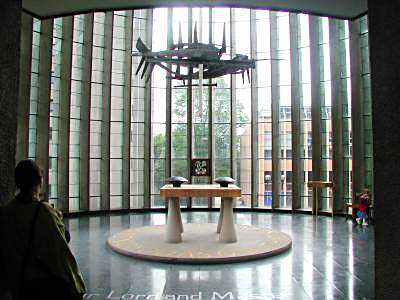
Finally, might I mention the ecumenical chapel at Coventry Cathedral. A deceased confrere, whose home was in Coventry, became involved in the ecumenical movement while in High School, back in the 60’s. Consequently, not long after he was ordained, he celebrated the Eucharist in the chapel at the Cathedral. I joined him for the occasion, I was still a seminarian at the time, and among the congregation, which represented all the major denominations present in the city, were also members of the Cathdral staff, including the Anglican priest who co-ordinated ecumenical events there.
Known as the Chapel of Unity, here is a link to a photo of the interior,
http://www.historiccoventry.co.uk/cathedrals/industry.jpg
And the story behind the chapel and its design is given here,
http://www.coventrycathedral.org.uk/wpsite/chapel-of-unity/ -
We have an interesting situation here in the San Francisco area, the chapel of St. Mary’s College (Christian Brothers) is also the parish church of St. Giles (Anglican/Episcopal). I have filled in there a number of times, and the sacristy is shared. The vestments are Roman Catholic (used by all), there is a separate shelf for the episcopal altar book and other items, otherwise, it is the same ‘stuff’. It does cause some confusion as the Episcopal mass is at 9:00 and the Roman Catholic mass at 11:00 on Sunday mornings, otherwise, it has been like this for 26 years!!
-
The Heathrow airport Christian chapel is in use by many groups and travellers of differing traditions and tongues. It normally presents a sparse, almost austere appearance but on one visit I was amused to see its speedy transformation into a more familiarly recognisable (Roman) Catholic space. The Sacristan dressed the plain bare table with cloths and crucifix and brought candles alongside. Then he pulled forward some plain columnar plinths and quickly topped them with brightly painted metre high statues of the Sacred Heart, our Lady and Saint Thérese -presumably hollow! The transformation was completed with a votive candle stand and small vases of flowers in front of the statues.
Having just flown in with Thai Air, we added our courtesy orchid buttonholes to the statues, and watched with amusement when one of the hostesses from our flight who had joined the “congregation” before Mass, recognised the flowers as she went up to read the lesson.
Mass over, the chapel was quickly restored to its sober self, a place for prayer and remembrance of crews of planes lost on flights connected with Heathrow. May they rest in peace and unity.
-
A slightly more exotic example from close to where I grew up is the church at Arundel. It is the Anglican parish church, but the east end is used by the Catholic Dukes of Norfolk as their family chapel/mausoleum.
-
I don’t have time to google it, but I recall reading about a similar Catholic and Episcopalian arrangement in, I don’t know – Virginia, maybe? It was within the past year or two and they had to, after many years of this practice, desist. Maybe it was not exactly the same thing. In any case, I enjoyed Teresa’s description of such a place.
-
http://www.holyapostlesvb.org/
Holy Apostles in Norfolk, VA – they have not, to my knowledge, had to desist. There is also a Lutheran/Catholic parish (Mission of the Atonement) outside of Portland, OR, still going strong after 20 years or so. I have visited there several times over the years; they celebrate the Liturgy of the Word together, then separate for the Eucharist. I was told an interesting story on one of my earlier visits there: when the proposal for this joint venture was first suggested, the at-the-time Archbishop Levada was asked about it, and he said, “Sure, let them try it; it won’t last six months.” So, whenever anyone questioned what they were doing, their reply was, “Oh, no – Cardinal Levada approved it.” End of conversation. -

Thanks for all the additional examples. I forgot to mention that the Altenberg abbey church did not become “bi” through ecumenical commitments but because. Prussian king decreed it so in the 19th century!
And to this day, it has two separate sacristies. -
I’ve proposed shared building arrangements for some of the “master planned communities” found in the American West, where developers reluctantly granted one or two “church lots” and let the various groups bid on them. I have dreamed of such an arrangement involving a Lutheran, Roman and Anglican joint-use sanctuary, but am quite certain that I will never see my dream come to pass, much less be the initiating Lutheran presence. Too sad in this day where there are so few examples of cooperation amongst Christians.
by
Tags:
Please leave a reply.