
I’m not one who believes that life’s coincidences are actually “signs” from God awaiting further interpretation. I do believe, however—along with the theologian/author Frederick Buechner—that coincidences can be opportunities for God to get our attention. Such a coincidence/opportunity occurred roughly two weeks ago, when I read the PrayTell blog post by Dr. Katharine Harmon (hereafter, Katie): Help, There’s a Monstrance in My Mass.
In that post, Katie recalled the parish liturgy she attended on the feast of the Body and Blood of Christ (Corpus Christi), the Sunday the U.S. Roman Catholic bishops had established as the inaugural Sunday of a years-long Eucharistic Revival to be observed in U.S. parishes. She described with excitement the rich possibilities she’d imagined for the day and for the revival itself. She was disappointed when what happened was the complete stopping of the eucharistic celebration (a.k.a. Mass) for Eucharistic Adoration. Cognitive dissonance ensued. After reading about her letdown, I felt somewhat glad on behalf of the various Roman Catholics I’d encountered (in person or on social media) who had absolutely no idea that this eucharistic revival was underway, much less what it was, and who may have endured similar situations.
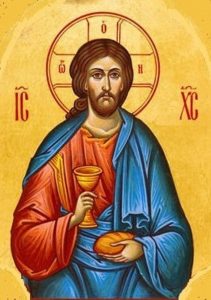
This “Monstrance at Mass” experience didn’t surprise me all that much. The initial impression one gets from the revival website is that eucharist=the communion elements (most often the host). This focus on the eucharist as an object and not an action tends, in my experience, to still make “ocular communion” part of the sacramental ethos. It is the individual’s passive seeing (whether at the elevation or in the monstrance) that is understood as central or primary, not the participation in communal celebrating. Eucharist as celebration and a communion host in adoration are really two quite distinct modalities, as are a picnic on the beach and a romantic candlelight dinner. Why we have such trouble with distinguishing between modalities for the eucharist and nowhere else in life mystifies me.
Getting back to the coincidence previously mentioned: Katie’s post was the first thing I read right after I’d finished proofreading musical settings of two new eucharistic hymn texts of mine—eucharistic hymn texts inspired by Sacrosanctum Concilium (SC, #7) which articulates the various modes in which Christ is present at the eucharistic liturgy: the gathered assembly and ministers, the Word, “especially under the Eucharistic species,” and when the Body of Christ—the Church—prays and sings. Full disclosure: this is likely my favorite part of SC (along with the reminder in #9 that liturgy does not exhaust the whole work of the Church). I am not sure why it took me decades to get to work on these texts. This coincidence prompted me to take the opportunity to look at some of the revival materials a bit more closely.
Initially, my new texts were prompted by a suggestion from my GIA colleague, Michael Silhavy. So I’d started to do some work (mostly on nuts ‘n’ bolts matters like structure, meter, rhyme, and so on), but the work was given a new impetus when I began to encounter the materials being assembled and put out for this eucharistic revival. One of the first things I noted was the absence of my beloved SC #7, save as an addendum (“see also”) to a footnote from the Catechism. Indeed, the major landing pages for the eucharistic revival contain no references to Vatican II whatsoever. This was but one oddity that emerged among some others:
• Though affirmed by the entire national conference of bishops, the work on the eucharistic revival materials seems to have been done solely under the auspices of the doctrine subcommittee, with no evident or acknowledged input from the liturgy subcommittee. The same was true of the doctrine group’s other recent liturgically-connected document on hymnody. I am not sure why these matters, which have the liturgy at their core, were treated as exclusively doctrinal subjects.
• A certain inaccuracy (a couple of theology profs in my past would have used the term “sloppiness”) in liturgical/theological language and use of church documents. It is regularly asserted that Vatican II referred to the Eucharist as the “source and summit” of the Church’s life. It is, however, the whole of the Church’s liturgy that was given this distinction, with the Eucharist given special note (as in #7).
• The overarching inaccuracies that Eucharist = communion elements / the Eucharist = the [whole of] liturgy / the Eucharist = the bread happen in a number of places. The visuals (as of this writing, there are no photos of a celebrating assembly) certainly reinforce this.
One of the catechetical documents on the site, “The Mystery of the Eucharist in the Life of the Church” does go into a bit more depth with more nuance in its thirty-five pages, and does acknowledge that Christ is present at the eucharistic liturgy in other ways. It was heartening that several pages of the document are given over to the connection between the Eucharist’s transformative power and the Church’s mission of social justice in the world (though the use of that transformative power for justice within the structures of the Church itself is not touched on).
Hopefully, Katie’s “Monstrance at Mass” experience will be an outlier. Likewise, may similar experiences in different guises not be part of this revival. Veni, Sancte Spiritus! Bring us and make us all the presences of Christ.
(The hymn texts referred to may be found here. You will note that their content is similar; they were set to the contrasting hymn tunes CRUCIFER and LAND OF REST in hopes of serving a variety of celebrations, and a variety of communities with different musical resources.)


Please leave a reply.