
At Commonweal in “Traditionalism, American-Style. A new kind of opposition to Rome,” Massimo Faggioli notes that the reaction to Traditionis custodes in the U.S. has been
“hostile (from those already militantly opposed to the pope) or lukewarm (from most of the U.S. bishops).”
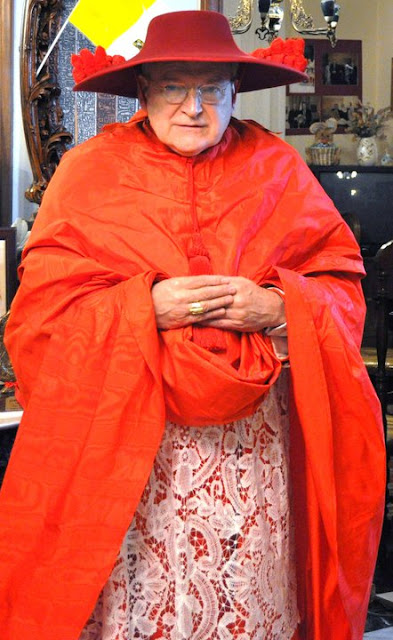
The more hostile reaction is seen in the recent book From Benedict’s Peace to Francis’s War: Catholics Respond to the Motu Proprio ‘Traditionis Custodes’ on the Latin Mass, which has chapters by Cardinal Raymond Burke and Archbishop Viganò. Faggioli says that the book “represent(s) an escalation in the rhetoric against Francis.” He sees “a crisis in urgent need of a Catholic-to-Catholic ecumenism.”
In Faggioli’s view,
“the center of Catholic neo-traditionalism is no longer exclusively French-speaking Catholicism in Europe, but conservative Catholicism in the United States. (In this sense it should be noted that the “globalization of Catholicism” does not necessarily make the Catholic Church theologically more progressive.) While there remains a French component to the opposition to Pope Francis and synodality, … the voice of American Catholic traditionalism has become louder than the French.”
Faggioli notes that
“though the new traditionalists make up a very small minority of Catholics, they nonetheless have an outsized voice both in conservative mainstream media and on social media,”
and that
“neo-traditionalism is attached to and benefits from the momentum of a political crisis in the United States.”
It overlaps with “Catholic Trumpism.”
In Faggioli’s telling, there are two sides in things liturgical. Either one supports Vatican II and the reformed liturgy to the exclusion of the preconciliar liturgy, or one shows greater or lesser openness to the preconciliar liturgy, which seems to be equated with opposition to Vatican II. This way of dividing things up was more or less the position of Paul VI, and it seems to be the position most compatible with the directives of Sacrosanctum Concilium.
But that doesn’t mean that everyone behaves themselves today by aligning with one or the other side. It would be interesting to explore further the mindset of those people who don’t fit neatly in either camp – those who, for example, happily worship primarily with the Vatican II liturgy, but don’t see the preconciliar liturgy as particularly bad or harmful and don’t mind attending it at times.
Perhaps these people are mistaken: the case can be made, and has been made ably by many, that the preconciliar liturgy is incompatible with the large advances made by the Second Vatican Council in ecclesiology and liturgical theology and inculturation and all the rest. What to do, then, with those ambivalent Catholics who do not see the incoherence of their liturgical sensitivities?
The number of such Catholics may be small, but they are overrepresented among younger clergy and laity, which means their influence, for better or worse, will likely increase in coming years. One can only hope that Francis is able to inspire these folks to adopt his and Paul VI’s interpretation of Vatican II, but that remains very much to be seen.
But Faggioli’s primary concern is not those whose somewhat conservative-leaning liturgical sensitivities impair their full acceptance of Vatican II. His focus is on the traditionalists who are most hostile to Pope Francis. And Faggioli calls out Benedict XVI for his role in setting up the current divisions these traditionalists are fomenting:
“(T)he rupture that Benedict XVI created in advancing liturgical traditionalism (see 2007’s Summorum Pontificum) and in his policies on Vatican II is something today’s traditionalists can exploit—and they do.”
In my view, and I don’t think Faggioli would disagree, Benedict XVI made a tragic miscalculation. He did not see that the liturgical infelicities and abuses in the manner of celebrating the postconciliar liturgy (Richard J. Neuhaus spoke of the “silly season”) were already in a process of self-correction by the 1980s and 1990s, and that the liturgy of Paul VI was beginning to come into its own as a beautiful and reverent celebration of the entire community. A sort of liturgical “re-Catholicization” was happily underway, but now, at its best at least, rooted in the genius of the reformed rite.
Benedict was still reacting to the liturgical problems of the 60s and 70s and thought, oddly, that the existence of the old liturgy would somehow improve the way the reformed liturgy is celebrated. We should take Benedict at his word that he accepted the so-called “ordinary form” of the Roman rite. He was never in the traditionalists’ camp, however much they appealed to him. He was in fact passionate about a more worthy celebration of the liturgy of Paul VI. His manner of getting there was questionable. If anything, Summorum Pontificum slowed down the process of “re-Catholicization” of the Pauline liturgy by pushing people into two opposing liturgical camps, thereby making defenders of the Pauline liturgy (the much larger camp) more defensive about the status quo.
Faggioli’s piece in Commonweal helpfully portrays the liturgical divide between those who fully accept Vatican II and those who do not. I hope my comments here help fill out the picture by also taking into consideration those who fall somewhere in between these contrasting positions. With their divided loyalties and their idiosyncratic understandings of Vatican II, they are a group to be taken seriously.
awr


Please leave a reply.