
It is finished. Probably it shouldn’t have been. Well enough should have been left alone. This past month the Roman Catholic Cathedral of Los Angeles, Our Lady of the Angels, announced the completion of its tapestry cycle.
The original tapestries by artist John Nava, installed for the dedication of the cathedral in 2002, are rightly considered among the most salient, sensitive, and sophisticated pieces of contemporary liturgical art in the United States.

But as a liturgical consultant and artist I must say I am not a fan of the five new panels recently installed behind the altar. Inexplicably, the new work by Nava lacks the subtlety in both conception and execution that marked the original saints in the nave and presbytery. The new image of a centralised Mary, perhaps slightly more palatable if we think of her as Mother of the Church, though the image tells us none of that, has lost all connection with the divinized humanitas so present and convincing in the original tapestries.

Here Mary looks like a socially-distanced, colouring book cut-out of kitschy saintliness. Perhaps she is to invoke the posture of the sculpted Mary over the cathedral’s festal entrance, but the halo effect on the tapestry leaves the impression of a somewhat decapitated corpse. From a distance the viewer is not even sure it is Mary. Perhaps the risen Lord? So, bam, in your face BLUE; This will compensate for any iconographic ambiguity, in a once monochromatic adobe inspired interior alla Moneo – originally an intelligent reference to nature and immigrant. And forget the two dancing angels flanking the mysterious and lonely floating figure.
 None of that close-packed saintly solidarity of the original masses, a glorious sandal-and-sneaker wearing people fully alive at the eternal banquet. Perhaps the only interesting feature is that the back weave of the five panels is a map of Los Angeles. But this graphic game is completely out of sync with the original tapestries too. The pattern is slightly echoed in the original Baptism of Jesus tapestry, but the pattern behind the altar comes across as heavy handed and derivative.
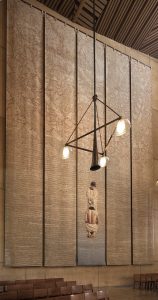 I don’t have insider information, but my instinct tells me that along the way process and patrons took control of this project. If I had to hazard a guess I’d probably blame a lot on that most enigmatic of happenings – when ordination makes all clergy art historians, art critics, artists, and liturgical experts. I could be wrong. I’d be happy to be wrong. But I have a hard time thinking that Nava, as a completion of his original work, would go this way and make these choices.
Perhaps more importantly, besides any artistic critique, the new tapestries make a schizophrenic sanctuary even worse. I dare say, they need to leave the altar, clear out the surrounding area, and start over. An already disparate sanctuary in its origins must now contend with yet two more disembodied elements that pull the eye in an uncontrollable and inarticulate cacophony: A worthy monumental altar, since-the-beginning awkward ambo and cathedra, the indecipherable charcoal black crucifix that once provoked me to write about liturgical ‘death-spaces’, and now a high-hovering blue question mark sandwiched between two pirouetting greeting card angels. I’m perplexed by the choice. Does the image not edge on Mariolatry? Would not Mary have been suitably located in a more eschatologically based scene that completed the logic of the gathered Church in heaven and earth already present in the original liturgical art? Mary dangling over an altar in an ‘apse’ is an odd choice. Colossians 1:18? At least in Byzantine art history she is present with her Son. Not here.


Please leave a reply.